
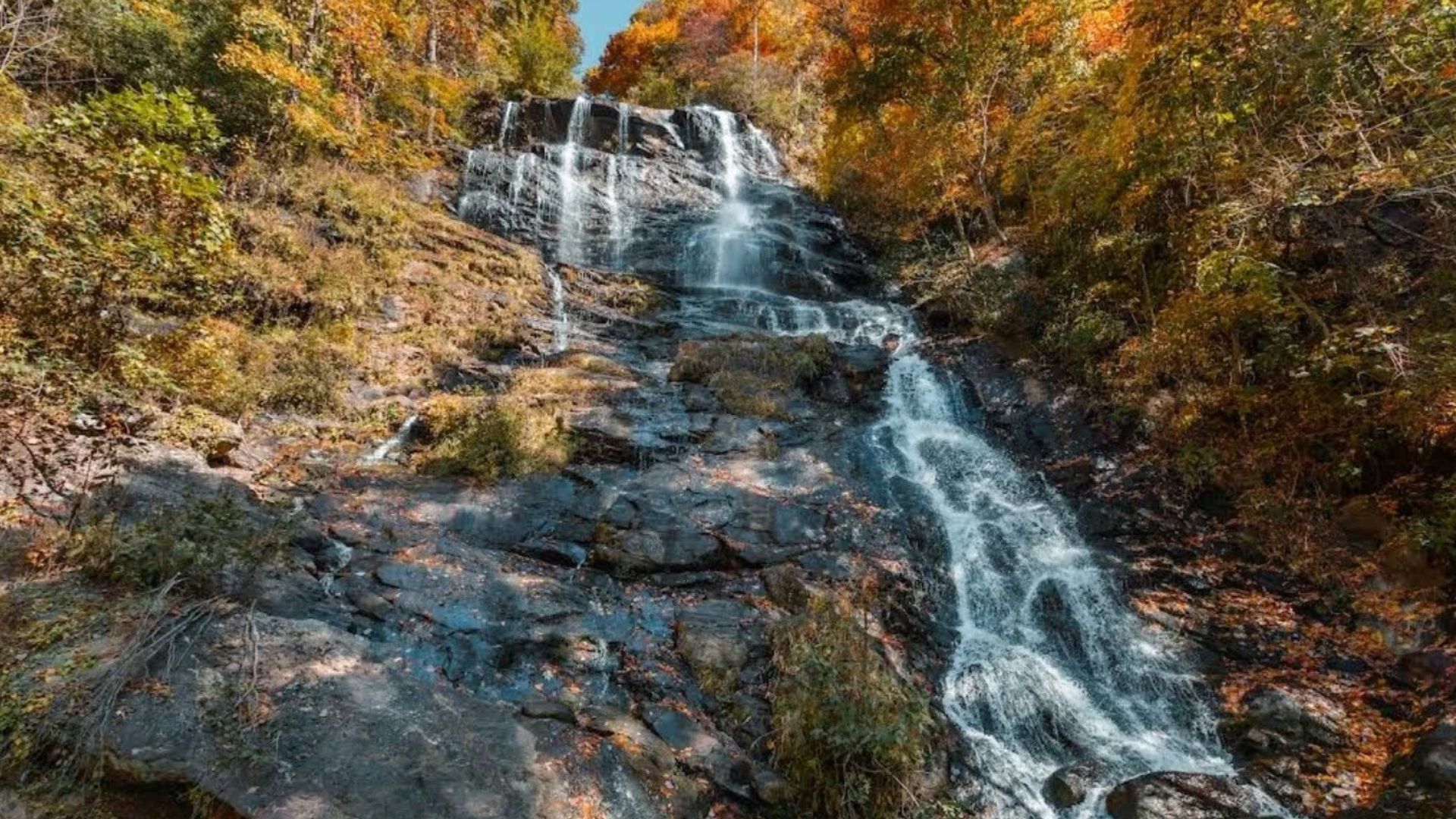
Georgia – You can hear the waterfall before you see the whole thing. Somewhere above the trees, water tumbles down a long rocky slope, disappears behind another ledge, and then returns in a sudden white rush. It is the kind of sound that makes people stop talking for a moment.
North Georgia has no shortage of beautiful mountain scenery, but a good waterfall has a way of claiming everyone’s attention.
The remarkable part is how many different experiences fit into a relatively small region. One waterfall drops hundreds of feet and has a staircase that makes your legs reconsider the outing.
Read also: Asheville’s River Arts District is back: 7 places to visit two years after Hurricane Helene

Credit: Georgia State Parks
Another waits at the end of a very short woodland path. Some are surrounded by state-park facilities, while others sit beside forest roads where the parking arrangements are much simpler.
If you’ve been putting off a Georgia waterfall trip because you assume every worthwhile view requires a strenuous hike, consider this your invitation to reconsider.
These six destinations offer a range of effort levels, and each rewards visitors in a different way.
Read also: Amazing Outer Banks lighthouses along a coastal drive, and which ones you can still climb
Before you go, match the waterfall to your energy
A waterfall’s height isn’t the same thing as the distance you need to hike to see it. Amicalola is the tallest on this list, yet its park offers several ways to appreciate the falls without completing every stair.
Raven Cliff requires a longer forest walk, while Minnehaha and Helton Creek are better suited to visitors who want a relatively quick stop.
Water flow changes throughout the year. After heavy rain, waterfalls may look dramatic but surrounding streams and trails can become dangerous.
Read also: Top 6 reasons this Michigan town of about 5,000 people is a Christmas favorite
During dry spells, the water may be gentler. Spring often brings strong flow, and late fall provides colorful scenery with fewer leaves blocking the view. Summer offers deep green surroundings but can also mean heat, humidity, and busy parking areas.
A practical note about money: Georgia’s state parks now charge a standard $10 daily vehicle parking fee, not the $5 figure still found in many older travel guides.
National forest destinations can have different rules, and some charge their own separate entrance or recreation fees. Check the specific site rather than assuming one park pass works everywhere.
1. Amicalola Falls
Amicalola Falls makes a spectacular first impression. The waterfall drops approximately 729 feet through a series of rocky cascades, earning its reputation as Georgia’s tallest waterfall. From a distance, the water appears to trace a pale ribbon down the mountainside.

Credit: Amicalola Falls via Maps
Closer up, the slope becomes a succession of ledges, tumbling channels, and viewpoints.
The name is commonly translated from Cherokee as “tumbling waters,” an appropriate description for a waterfall whose scale makes it difficult to capture in one photograph. This is a destination where the experience changes depending on where you stand. The lower viewpoints emphasize the height, while elevated locations reveal the forested setting and the way the water descends in stages.
The famous stair route involves more than 600 steps and is a substantial climb. It can be enjoyable for fit visitors who want exercise with their scenery, but it isn’t necessary for everyone. Park facilities and shorter accessible sections provide alternatives, so check the official trail map and choose a route appropriate for your group.

Credit: Amicalola Falls via Maps
Amicalola Falls State Park is near Dawsonville, roughly an hour north of Atlanta under favorable driving conditions. The standard Georgia state park daily parking pass is $10 per vehicle.
Read also: Some of the best Nashville hot chicken joints where the heat comes on white bread with pickles
If you want to take photographs, allow time at several viewpoints rather than trying to fit the entire scene into one hurried stop.
The surrounding park also provides lodging and other outdoor activities, which makes it suitable for an overnight trip.
A chilly morning or misty afternoon can give the falls a completely different character. Bring a jacket and wear shoes suited to stairs and damp stone. The waterfall is spectacular, but it doesn’t make the steps any less steep.
2. Anna Ruby Falls
Anna Ruby Falls offers a more compact and approachable outing near Helen. The setting is beautiful enough on its own: a wooded trail beside a lively stream, with the mountain forest gradually opening toward a pair of cascades.
At the end of the route, Curtis Creek drops about 150 feet, while nearby York Creek falls roughly 50 feet. The streams meet below, creating a scene that feels carefully arranged even though the entire composition is natural. The twin falls are especially appealing because visitors can see two different shapes of falling water from established viewing areas.

Credit: helenga.org
The main paved trail is about half a mile each way and climbs gradually. The surface is more developed than many national forest paths, though it is not flat and can require effort. A separate short Lion’s Eye interpretive trail near the visitor facilities improves access to parts of the site. The approach and viewing areas are well suited to families who want a memorable nature stop without a full-day wilderness hike.
There is a practical detail older guides frequently get wrong: the current admission charge is $6 for visitors sixteen and older, with children fifteen and younger admitted free. The site is managed by FIND Outdoors in cooperation with the U.S. Forest Service, and Georgia State Park passes do not cover this admission. Visitors pay at the Anna Ruby gatehouse rather than assuming the nearby Unicoi State Park entrance handles the transaction.
Read also: Must-see Julian-area bakeries where the apple pie comes out warm, flaky and piled high

Credit: helenga.org
The visitor center lists daily hours of 9 a.m. to 6 p.m., with last ticket sales at 5 p.m., subject to weather and holiday closures. It’s worth arriving with plenty of daylight. The walk is part of the pleasure, and it’s much nicer when you don’t spend the return trip worrying about the closing time.
3. Tallulah Gorge
Tallulah Gorge isn’t simply a waterfall destination. It is an entire landscape organized around a deep cleft in the earth, nearly two miles long and about a thousand feet deep in places. From the rim, the river and waterfalls are far below. The scene can make even experienced hikers stop and look twice.
The state park is known for a series of waterfalls, rugged overlooks, and a suspension bridge high above the gorge floor. The bridge offers a memorable perspective, but reaching it involves a demanding number of stairs. Don’t assume it is a casual stroll merely because the visitor center is nearby.

Credit: Georgia State Parks
Families who prefer a gentler outing can focus on rim viewpoints and interpretive facilities. More ambitious hikers may choose longer routes, provided conditions and park rules allow. Access to the gorge floor is restricted and can require a permit; water-release events may close some trails. Check the state park’s current alert and release schedule before committing to a particular route.
Tallulah Gorge State Park requires the standard Georgia parking pass, currently $10 per vehicle for a regular daily visit. There may be separate requirements for specialized activities. The park is one of the most visually impressive stops in the region, but it deserves enough time to appreciate safely.
In autumn, the wooded walls become colorful, making the gorge look even deeper. During scheduled higher-flow releases, the river becomes especially energetic, though trail restrictions also increase. Choose the experience you want before arriving: an easy rim-view afternoon or a serious staircase outing. Either can be rewarding. The important thing is not confusing them.

Credit: Georgia State Parks
4. Minnehaha Falls
Minnehaha Falls is a lovely reminder that great scenery doesn’t always demand an exhausting climb. Set near Lake Rabun, the waterfall descends over a broad, gently sloping rock face, spreading the water into multiple delicate streams. The overall drop is commonly described as around 100 feet.
The trail begins near Bear Gap Road and follows a wooded path to the falls. Different guides describe the short distance in slightly different ways, but the approach is usually considered roughly four-tenths of a mile. Many visitors can complete it comfortably, although a “five-minute walk” depends on pace, footing, and exactly where the car is parked.
This is the destination to consider if you’ve been driving through the mountains and want one beautiful stop without building an entire day around a hike. The waterfall’s layered shape is particularly photogenic after a period of healthy rainfall, when water spreads across the rock in several channels.

Credit: Minnehaha Falls via Maps
Parking is limited along a forest road. Do not block the roadway or assume that a small pullout can accommodate every visitor on a busy weekend. The area has no general admission charge in current official tourism information, but access is less developed than at the major state parks.
The path may have roots, wet leaves, and slick sections. Even a short hike deserves proper footwear. Once you reach the waterfall, stay back from the wet rock and enjoy the entire scene. Minnehaha’s beauty comes from the way water moves over the broad slope; there is no need to step into the stream to appreciate it.
5. Helton Creek Falls
Helton Creek Falls offers something that appeals to families who like a little variety without a long hike: two waterfalls reached by a short wooded trail. The upper and lower cascades are commonly described as roughly 50 and 30 feet, though exact figures vary by source and method of measurement.
Located in the mountains near Blairsville and Vogel State Park, the falls are reached by local and forest roads. The approach is not a major highway attraction, so check current road conditions before leaving. Some stretches can be narrow or rough, particularly after storms, and a low-clearance vehicle may make the journey less comfortable.
Once on the trail, the forest feels pleasantly enclosed. The two falls have different shapes and viewing positions, giving visitors reasons to pause twice rather than simply walk to one destination and return. On a quiet weekday, the sound of moving water can dominate the entire scene.
This is a good destination for people who enjoy a modest walk and a relaxed picnic elsewhere in the area. However, don’t treat the waterfall base as a picnic table or let children scramble over slick boulders to get closer. Wet rocks can become slippery without warning, and stream flow may change after rain upstream.
Published descriptions generally present this as a free national forest outing, but check current Forest Service notices for road closures, maintenance, or any recreation restrictions. It’s better to confirm access than spend a long drive discovering that weather has made the final road unsuitable.
6. Raven Cliff Falls
Raven Cliff Falls asks a little more from visitors. Near Helen, the trail follows Dodd Creek through a wooded valley toward a dramatic waterfall that descends through a split in a rock face. The route is often described as roughly five miles round trip, making it better suited to hikers with time, water, and suitable footwear.
The journey is part of the attraction. The creek provides a steady soundtrack, and smaller cascades appear along the way. There are shaded sections, rocky crossings, and enough changes in terrain to keep the walk interesting without turning it into a summit climb.
The main waterfall’s unusual rock opening gives it a distinctive personality. Rather than spreading across a broad stone wall like Minnehaha, the water seems to emerge through the cliff itself. That final view rewards patience, especially if you’ve stopped along the stream to appreciate the smaller features on the route.
Allow several hours for the outing. The trail may be wet, uneven, or crowded during popular weekends. The trailhead area may have recreation parking fees and limited spaces, so check current U.S. Forest Service information rather than assuming every forest trail is free. Carry water and avoid planning the walk so late that you might return after dark.
This is not the best option for someone who simply wants to see a waterfall from the car. It is better for people who enjoy hiking and are happy to let the forest unfold at its own pace. The payoff feels larger precisely because you’ve walked to reach it.
Choosing the right waterfall weekend
If you’re traveling with children or visitors who prefer shorter walks, begin with Anna Ruby Falls and Minnehaha. Helton Creek may also work if road conditions are good. For a big scenic statement without the most demanding hiking route, visit Amicalola and choose its easier viewpoints rather than committing to the entire staircase.
Tallulah Gorge belongs on the list for travelers who enjoy wide views and dramatic geology, though the stairs require thought. Raven Cliff is the full hiking experience, best saved for a day when everyone has sufficient energy and time.
A two-day itinerary can cover several falls without feeling rushed, especially if you stay around Helen, Blairsville, or another mountain community. But don’t use the list as a competition to collect all six in one afternoon. Parking, mountain roads, and weather can make travel slower than a map suggests.
Most importantly, respect the water. Stay on marked trails, never cross a swollen stream, and do not climb onto wet ledges for photographs. A waterfall is most beautiful when you can enjoy it without putting yourself or a rescuer in danger.
North Georgia makes a strong case for the simple road trip: good scenery, a comfortable pair of shoes, and enough flexibility to stop when you hear water moving through the trees. Whether you choose a five-minute stroll or a half-day hike, the best reward is often the moment you finally reach the falls and realize there’s no reason to hurry away.


