
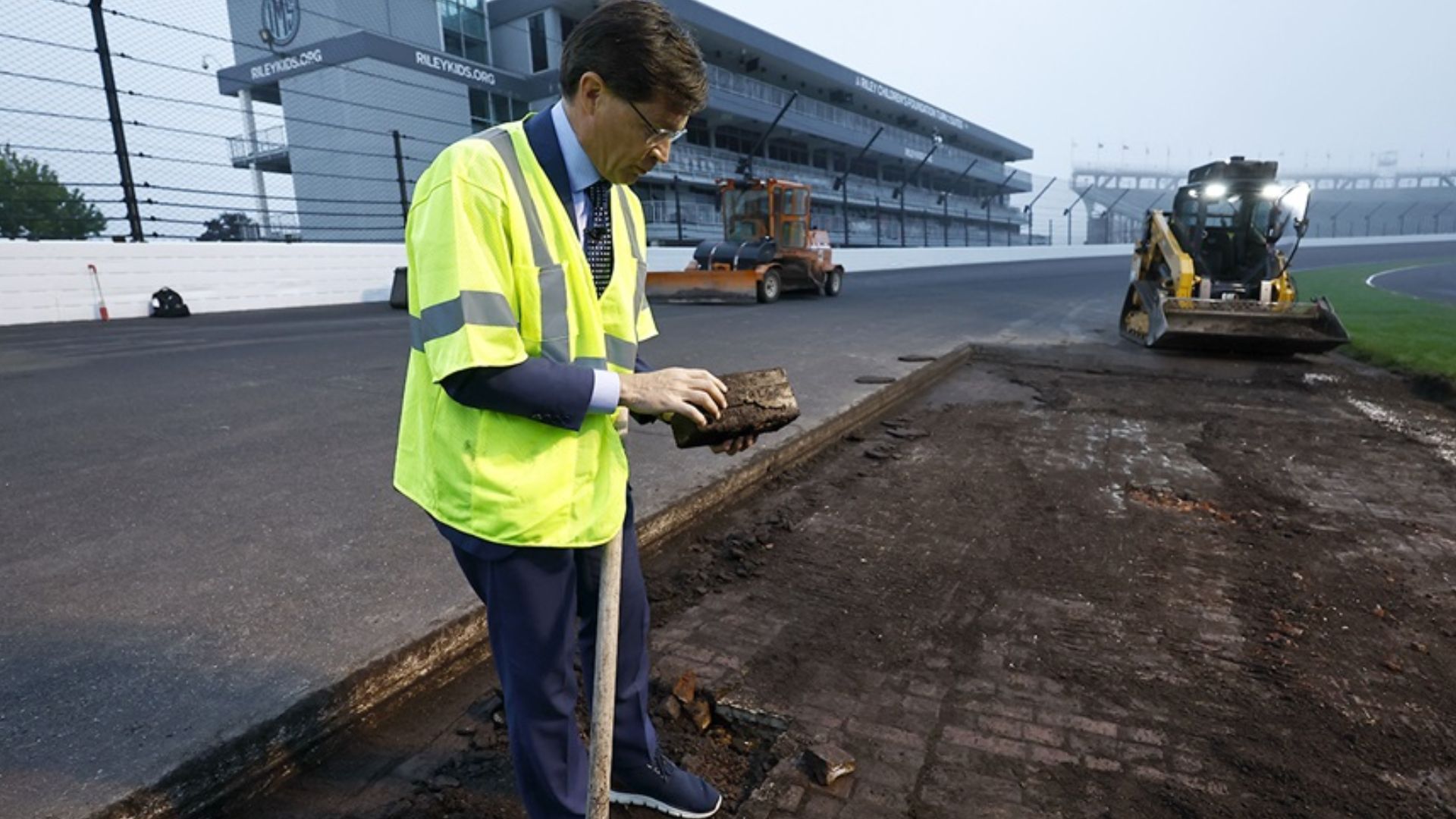
Indianapolis, Indiana – Indianapolis Motor Speedway is stepping back into its own history—quite literally—after a repave project earlier this fall peeled away layers of modern asphalt and revealed the buried heart of the iconic 2.5-mile oval. What started as a routine fix to address a persistent bump in Turn 2 suddenly opened a window to 1909, exposing the original bricks and, even more shockingly, a preserved slab of the crushed stone-and-tar surface that predates the speedway’s famous paving.
Now IMS is turning that unexpected discovery into a full storytelling experience. Beginning Monday, Dec. 8, the Speedway will roll out a four-part miniseries as part of its long-running “Behind the Bricks” program. Episodes will drop daily through Thursday, Dec. 11, followed by a feature-length documentary premiering Friday, Dec. 12. Everything will be available across the track’s social platforms—Facebook, Instagram, Threads, TikTok, X and YouTube—making the project easily accessible to fans across the globe.
IMS teased the project with a trailer released today, giving viewers their first glimpse of the dramatic excavation that unfolded beneath a seemingly ordinary patch of asphalt. The blunt cut of heavy machinery peeling back pavement, the surprise appearance of century-old brickwork, and the almost archaeological look of the stone-and-tar layer beneath it all produced a wave of awe across motorsports corners of the internet.
This miniseries promises to slow down that moment and let fans feel its full weight. Viewers will see engineers at work, the field of bricks as it appeared before sunlight touched them for the first time in 116 years, and interviews that help frame why such a discovery matters. Among the featured voices is former IMS Historian Donald Davidson, whose insight anchors the project firmly in the Speedway’s long legacy.
Indianapolis Motor Speedway and INDYCAR President J. Douglas Boles captured the sense of wonder at the center of the project. “It’s not often that we get to really see the full history of the Indianapolis Motor Speedway in front of our eyes,” Boles said. “What started as a project to fix a bump in Turn 2 turned into a historic, and at times, overwhelming exploration that uncovered aspects of his racetrack that have not seen the light of day, literally, in over 116 years. I can’t wait for our fans to see it all unfold on ‘Behind the Bricks.’”
The repave has become more than a maintenance effort—it has become a physical reminder of the track’s earliest days. When the Speedway opened in 1909, the racing surface consisted of crushed stone and tar, a combination that quickly proved unpredictable and dangerous. By that fall, construction crews replaced it with 3.2 million bricks, giving rise to the nickname that still echoes through the sport: The Brickyard. The final sections were installed in early December of that year, just in time for a dedication by then-Indiana Governor Thomas Marshall, who would later serve as Vice President of the United States.
Over the decades, as speeds climbed and technology evolved, the original brick surface slowly disappeared under layers of asphalt. By 1937, all four turns were paved over. More paving followed in 1938, 1939, 1961, 1976, 1988, 1995 and 2004. With each update, the bricks settled deeper below the racing line, eventually resting about seven inches under the surface—still present, still part of the track’s identity, but hidden.
Yet the Midwest’s freeze-thaw winters had other ideas. As temperatures swung from icy cold to spring warmth, the buried bricks shifted microscopically, pushing upward and creating bumps through the asphalt. IMS had long managed the issue by grinding the surface smooth, but the recurring Turn 2 problem finally signaled that a more permanent solution was needed.
That solution arrived in September, when crews milled down the asphalt and physically removed the problem-area bricks. The Speedway intends to preserve them, storing the pieces as artifacts of the facility’s layered construction history. Meanwhile, the section of crushed stone and tar pulled from the site is already displayed at the Indianapolis Motor Speedway Museum, giving fans a rare look at the Speedway’s original texture.
The miniseries shows how the repave unfolded from there. After excavation, a fresh layer of asphalt was installed over a 100-foot-wide stretch that spans the full width of the track. Specialized diamond grinding was then used to blend the new material into the old, creating a seamless feel for drivers heading into one of the most crucial portions of the oval.
Before the project was officially declared complete, defending Indianapolis 500 champion Alex Palou and two-time winner Takuma Sato took to the track on Oct. 21 for a test session. Their feedback reinforced the success of the repave.
“It’s a little bit smoother, which I think is going to be a huge gain for the race, especially when we’re following cars,” Palou said. “It’s great. I cannot wait to go racing.”
For IMS, the repave—and the miniseries documenting it—serves as both preservation and preparation. The Speedway continues to honor its past even as it gears up for the future, including the 110th Running of the Indianapolis 500 presented by Gainbridge. Tickets for the Month of May are already available at IMS.com, setting the stage for another season of high speeds, packed grandstands and renewed appreciation for the track’s unmatched history.
Through “Behind the Bricks,” fans will see not just the asphalt surface that drivers will charge across next May, but the layers beneath it—the ones that carried the earliest cars, the ones that shaped the Speedway’s identity, and the ones that patiently waited more than a century to be seen again.


