
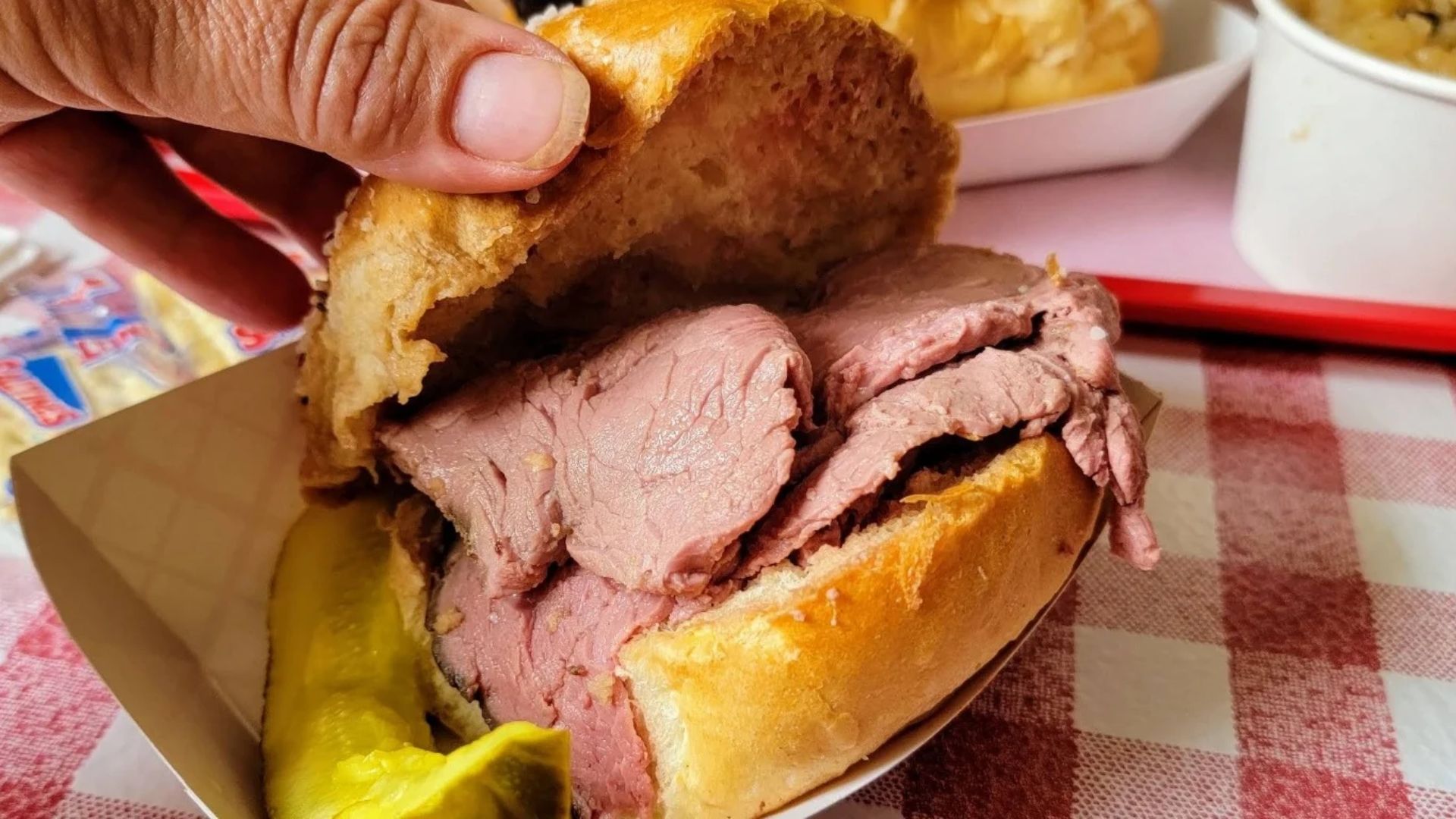
Buffalo, New York – The first clue is the roll. Its top is scattered with coarse salt and caraway seeds, so it looks more assertive than an ordinary sandwich bun.
Then comes the roast beef, piled high enough that you’ll probably need both hands. Horseradish waits nearby, the meat is still juicy, and the first bite explains why Buffalo has been defending this sandwich for generations.
Most visitors arrive in western New York knowing about Buffalo wings. That makes sense. Wings have a famous origin story, a dedicated local culture and enough spicy variations to keep a traveler occupied for days.

Credit: Schwabl’s
But ask someone who grew up here what else you should eat, and beef on weck is likely to enter the conversation very quickly.
It isn’t complicated. In fact, that’s part of its appeal. Tender sliced roast beef goes inside a kummelweck roll, often accompanied by horseradish and a little meat juice.
The result is salty, savory, sometimes messy and wonderfully satisfying. You don’t need a complicated list of toppings to make it work.
There are plenty of versions around Buffalo. Some places carve the beef in view of customers, while others prepare it for a quicker counter-service order.
Read also: 8 Reading terminal market stands Philadelphia locals say you can’t skip

Credit: Charlie The Butcher’s Kitchen
These six spots give you an opportunity to understand both the history and the range of the sandwich, from an old-fashioned dining room to a custard shop serving hot roast beef.
First, a little about that peculiar roll
The word weck is a shortened form of kummelweck, the German-influenced roll that gives the sandwich its unmistakable character. Coarse salt and caraway seeds on top distinguish it from an ordinary kaiser roll. That seasoning adds a sharp, aromatic contrast to the richness of the beef.
Read also: 6 Chicago beef stands where the Italian beef comes dipped, juicy and topped with giardiniera
Buffalo’s beef-on-weck story reaches back to the nineteenth century, although the precise inventor and original recipe remain subjects of competing accounts. Local taverns and German-American baking traditions helped shape the food. What is clear is that the sandwich was established long before Buffalo wings appeared on the national culinary scene.
Traditional accompaniments are simple. Horseradish adds heat that travels quickly through your nose rather than lingering like hot pepper sauce. Meat juices, sometimes offered as au jus, keep the filling moist and soften the bread.
The combination can be a little tricky to eat neatly. That is not a flaw. A generous sandwich often leaves salt on your fingers and requires a few napkins. If the top of the roll tastes too salty, some locals brush away a little of the seasoning before eating.
And while visitors sometimes assume every establishment carves beef directly in front of them, that isn’t true of all six recommendations. The essential connection is to the same Buffalo sandwich tradition, served in different ways.
1. Schwabl’s — West Seneca
At Schwabl’s, ordering beef on weck feels like participating in an old Buffalo ritual. The restaurant’s history is commonly traced to 1837, and its current West Seneca setting has served the specialty for decades.

Credit: Schwabl’s
The most memorable detail is the carving. Roast beef is cut near the dining room bar, turning an ordinary sandwich order into a small performance. There’s no need for theatrical presentation when a skilled worker and a piece of roast beef can provide all the entertainment.
Schwabl’s also has a fascinating connection to Buffalo’s 1901 Pan-American Exposition. Accounts of its history describe sandwiches being sold there for fifteen cents, an extraordinary reminder of how long the food has mattered in this region.
What should you order? Begin with the classic beef on weck. Let the roast beef and kummelweck roll make their impression before applying a generous amount of horseradish. A little is often enough. The condiment has a habit of announcing itself very quickly.
The dining room has an old-fashioned character that suits the food. Rather than rushing through a takeaway meal, sit down and enjoy the feeling of visiting a business closely connected to Buffalo’s culinary history.

Credit: Schwabl’s
Schwabl’s is in West Seneca, south of central Buffalo, so it is best included in a car-based food outing rather than an entirely downtown walk. Check current opening days before making a special trip; independent family restaurants don’t always maintain the same schedule as national chains.
If you visit just one place specifically to understand what carving roast beef for a sandwich looks like, Schwabl’s is a particularly appropriate choice.
2. Charlie The Butcher’s Kitchen — Williamsville
Some family businesses develop reputations through one remarkable recipe. Charlie the Butcher has something even more interesting behind it: a long association with the meat trade itself.
Charlie Roesch belongs to a family with generations of butchering experience in western New York. That history helps explain why a roast beef sandwich became the center of the operation. The kitchen at 1065 Wehrle Drive, near the Buffalo airport, has been a recognizable destination since the early 1990s.

Credit: Charlie The Butcher’s Kitchen
The setting is more casual than Schwabl’s. It works particularly well for travelers arriving or departing through the airport, or anyone looking for a quick but distinctive local lunch.
The specialty is hot roast beef sliced for beef on weck. The roll carries the familiar salt and caraway seeds, while horseradish provides the traditional punch. The business has also been connected to Buffalo’s Broadway Market, where older local food traditions remain visible.
One of the pleasures of visiting a place like this is that the menu doesn’t require a great deal of study. You can simply order beef on weck and concentrate on the sandwich itself. If you’re especially hungry, ask about sides or combination options at the counter.
A sandwich prepared by a business rooted in butchering offers a different kind of appeal from a pub that treats beef on weck as one of many menu items. Here, the roast beef is central to the identity.
Allow extra time around the lunch rush, especially on days when airport traffic and local customers overlap. The short drive from the terminal makes it convenient, but also means you shouldn’t leave the visit until the last possible minute before a flight.
3. Bar-Bill Tavern — East Aurora
East Aurora is worth a visit even before you consider its food. The village has a handsome Main Street, independent shops and a calmer atmosphere than central Buffalo. Add Bar-Bill Tavern, and it becomes a particularly strong destination for a hungry afternoon.
The tavern is best known nationally for its Buffalo wings, but beef on weck has an equally devoted following. In a 2017 Buffalo Eats tasting competition, Bar-Bill’s version took the top spot ahead of Schwabl’s in the final. That is a specific competition result rather than proof of an objective statewide ranking, but it helps explain the enthusiasm around the sandwich.
The beef arrives on the traditional salted roll, accompanied by the sharp horseradish that fans expect. The contrast with the tavern’s famous wings makes ordering both tempting. Sharing a sandwich and a wing order can be a fine introduction to two different parts of Buffalo’s food culture.
The original tavern stands at 185 Main Street in East Aurora. The atmosphere is casual and lively, and weekends can become crowded. A wait isn’t unusual at a well-known neighborhood restaurant, particularly when sports and tourism add to the local traffic.
If you care about seating rather than a bustling bar experience, consider visiting outside the busiest dinner period. Current payment options should be checked before traveling; older guides sometimes call Bar-Bill cash-only, but that detail can change.
Here’s a pleasing way to spend a day: browse East Aurora’s streets, settle into Bar-Bill for lunch, and leave enough room to compare the wings with the beef on weck. You may discover that choosing a favorite is harder than expected.
4. Steve’s Pig & Ox Roast — Lackawanna
The name promises meat, and Steve’s delivers a very different style of roadside tradition. At 951 Ridge Road in Lackawanna, south of Buffalo, this family operation has served slow-roasted meats for decades.
The restaurant’s roots go back to 1978. Regional reporting describes the business staying within the family while generations of customers returned for roast beef, pork and other meats cooked over charcoal.
That charcoal connection makes Steve’s worth seeking out. Its style isn’t identical to the hand-carved dining room experience at Schwabl’s, but it gives visitors another way to appreciate the importance of roasting technique in a sandwich.
The beef sandwich is a natural place to begin. Ask how it’s currently served and whether a kummelweck roll is available. The restaurant also offers other roasted meats and familiar sides, so it works well for a group whose appetites extend beyond one specialty.
There’s an appealing family story behind the counter. In a local television report, owner Marvin Barberich described his uncle starting the business and relatives continuing to prepare foods such as pies and cookies. The operation was presented as a place where regular customers were known and the cooking methods remained important.
Recent restaurant directories still list Steve’s as operating, generally six days a week with Sunday closed. Listings also describe a cash-only policy, but verify that before visiting, because payment rules can change without much notice.
The location makes sense for a wider food drive around Buffalo’s southern suburbs. It is more about the roast-beef tradition and the family operation than a glamorous dining room. For anyone who enjoys old-fashioned meat sandwiches, that’s a good reason to stop.
5. Anderson’s Frozen Custard — Multiple Buffalo Locations
A frozen-custard shop might sound like an unusual place to continue a roast beef tour. Then you remember that Buffalo food culture has never been particularly concerned with making its traditions easy for outsiders to categorize.
Anderson’s Frozen Custard is known for ice cream and custard treats, but its menu also includes roast beef sandwiches, including beef on weck. With several locations across the Buffalo area, it can be one of the easiest places to sample the specialty without planning an entire afternoon around a historic tavern.
The experience is more straightforward than at an old dining room. Order at the counter, receive your sandwich and find a place to enjoy it. The focus is convenient service rather than the atmosphere of a nineteenth-century pub.
That doesn’t make the sandwich less interesting. The traditional kummelweck roll and roast beef remain the essential pairing, and customers who want a familiar, accessible introduction can find it here.
There’s also a wonderfully practical bonus: dessert is waiting. After a salty, savory sandwich, a serving of frozen custard can provide a pleasant contrast. It’s an odd combination only until you’ve tried it.
Anderson’s has multiple locations, and offerings or schedules may vary slightly. Check the individual store you intend to visit and confirm that beef on weck is available that day.
This is a particularly helpful option for families traveling with children, or groups in which one person is devoted to roast beef and another is mostly interested in ice cream. Rather than debating two destinations, you can accommodate both appetites in the same stop.
6. Buffalo Brew Pub — Williamsville
Beer and beef on weck make a very sensible pair. At Buffalo Brew Pub in Williamsville, the combination fits naturally into a casual restaurant experience with a distinctly western New York identity.
The brewpub stands at 6861 Main Street, outside central Buffalo. Its menu includes a section devoted to Buffalo traditions, and beef on weck is one of the local dishes represented there.
That matters because the sandwich isn’t treated as an obscure special that might appear only once a year. It is part of the regional food story the pub wants customers to recognize.
Order the beef on weck and consider a beer from the available selection, choosing something that doesn’t overwhelm the meat. The salty caraway roll and roast beef already provide plenty of flavor. A straightforward lager or another lighter beer can be an easy pairing, depending on your preference.
This is a more relaxed, sit-down option than a busy counter lunch. It may appeal to visitors who want to linger, enjoy conversation and sample the sandwich alongside other pub food.
The restaurant’s published menu currently lists beef on weck under its regional specialties. Prices and serving details can change, so use the current menu rather than an old review if you’re planning around a budget.
For travelers staying near Williamsville or the airport area, Buffalo Brew Pub provides a convenient way to experience a classic local food without driving downtown.
It is also a useful final stop in a friendly informal taste test. After trying several versions, you may notice how much of the appeal depends on little details: how the beef is sliced, how much salt is on the roll, and whether the horseradish arrives already spread or separately.
How to order like someone who knows the sandwich
The first rule is simple: don’t be afraid of horseradish, but treat it with respect. Its heat is different from hot sauce, and a small amount can make a strong impression. If you’re unfamiliar with it, try a little on one bite before adding more.
Next, think about moisture. Roast beef that is too dry can make even a good roll disappointing. Some places serve the sandwich with meat juices or au jus, while others rely on the natural moisture of freshly sliced beef. Ask what comes with your order rather than expecting every shop to serve it identically.
The roll matters just as much as the filling. A proper kummelweck top is salty and studded with caraway. It should contribute flavor rather than merely hold the meat. If you’re especially sensitive to salt, brushing away some of the coarse crystals is an acceptable personal adjustment.
And finally, remember that a sandwich can be excellent without requiring an argument about where the best one is sold. Different places offer different experiences. Schwabl’s emphasizes carving and history. Charlie the Butcher brings a butchering legacy. Bar-Bill offers a lively tavern, Steve’s a charcoal-roast tradition, Anderson’s convenience and custard, and Buffalo Brew Pub an easygoing beer-and-sandwich lunch.
Buffalo’s other great sandwich deserves its own road trip
The beauty of beef on weck is how little it asks you to learn. There’s roast beef, a distinctive roll and a few condiments. That’s almost the entire formula. Yet a century of local pride has grown around the details.
You don’t need to visit every stop in one day. In fact, that would be a great deal of roast beef. Pick a couple, explore the surrounding neighborhoods and allow yourself time to appreciate the small differences.
Buffalo wings will probably remain the city’s most famous export. But when a salty kummelweck roll arrives packed with tender beef, it becomes obvious that the region has at least one other sandwich worth taking very seriously.


