
Indianapolis, Indiana – From dense tropical forests to smallholder farms on the edge of protected land, a new Indiana University–led research project is taking a wide, interconnected look at how chemicals used in agriculture move through the environment—and how those chemicals may affect both people and wildlife. Backed by a more than $1 million grant from the National Science Foundation, the work centers on pesticide exposure and is led by Michael Wasserman, an associate professor of anthropology and human biology in IU Bloomington’s College of Arts and Sciences.
Wasserman’s research sits at the intersection of biology, environment, and human behavior. For years, his work has focused on how chemicals—both naturally occurring and human-made—interact with the endocrine system in primates and humans. The endocrine system regulates hormones that influence growth, reproduction, metabolism, and behavior, making it especially sensitive to outside chemical interference. While much research has examined chemical exposure in industrialized settings, Wasserman’s work stands out for its focus on rural landscapes and wildlife living far from obvious sources of pollution.
His earliest studies explored tropical forests, where primates consume plants that naturally contain hormone-like compounds. Those findings raised deeper questions about how chemicals from the environment enter the body and what effects they may have over time.
“At a broad level, what I work on are interactions between primates and exogenous, or external, chemicals that interact with the endocrine system,” Wasserman said. “Chemicals coming from the environment into the body that can mimic hormones, bind to hormone receptors and have physiological and potentially behavioral effects because of that activity.”
After joining Indiana University, Wasserman expanded his focus to include chemicals introduced by human activity. A collaboration with environmental chemist Marta Venier at IU’s O’Neill School of Public and Environmental Affairs opened the door to studying pollution exposure in wild primates—an area that remains surprisingly underexplored.
“When we started it, we didn’t really know what we were going to find,” Wasserman said. “There just aren’t many people studying pollution exposure in primates.”
Fieldwork conducted in forested areas of Costa Rica and Uganda revealed an unexpected picture. Air samples collected in these locations detected pesticides and flame retardants, chemicals typically associated with agricultural or industrial use. Further analysis of primate fecal samples confirmed that monkeys and apes were not just encountering these pollutants but ingesting them.
Those discoveries shifted the direction of the research. If chemicals were appearing deep in forest ecosystems, where were they coming from? And how were nearby human activities shaping exposure for both wildlife and people? To answer those questions, Wasserman moved his research focus beyond the forest canopy and into neighboring farming communities.
The current phase of the project is supported by a National Science Foundation grant through the Dynamics of Integrated Socio-Environmental Systems program. Centered on 12 communities surrounding Kibale National Park in western Uganda, the study examines how household-level farming decisions connect to environmental contamination and biological exposure across entire landscapes.
Phase 1 of the project, completed last year, involved surveys of roughly 600 households. Researchers gathered detailed information on farming practices, pesticide use, environmental change, and access to agricultural products. The data provided a snapshot of how agriculture is evolving in the region.
“Uganda is going through a major agricultural transition,” Wasserman said. “Moving away from traditional farming methods to more intensive pesticide and fertilizer use to increase productivity.”
That transition is driven by multiple pressures, including climate variability, increased pest activity, and the need for reliable food production. Phase 2 of the study, now underway, takes a deeper look by following 108 households over the course of a full year, allowing researchers to capture seasonal changes in farming and exposure.
“Each household keeps a diary of farming practices, what chemicals they use, when they use them and what crops they’re applied to,” Wasserman explained.
At the same time, the research team is measuring chemical exposure across three interconnected domains: people, wildlife, and the environment. Human exposure is tracked using silicone wristbands worn by participants. These bands absorb chemicals encountered through the air or skin contact during daily activities, offering a personalized record of exposure. Environmental exposure is measured through air sampling conducted in and around homes, farms, and nearby landscapes. Wildlife exposure is assessed through fecal samples collected from primates living in and near Kibale National Park.
Together, these data streams allow researchers to map how chemicals move from farms into the air, into bodies, and across species boundaries.
Wasserman notes that many farmers are increasing pesticide use as they respond to shifting environmental conditions.
“We suspect that farmers are using these pesticides more and more because they’re perceiving environmental risk that is changing due to shifts in climate, dealing with more fungal growth, more insect pests,” Wasserman explained.
At the same time, some participants have reported health concerns, including nausea, burning eyes, and loss of appetite. These experiences highlight the difficult balance farmers face as they work to protect crops while also protecting their own health.
“They have to maintain food productivity for food security, but also, everyone we’ve talked to, from households to government officials, is interested in these tradeoffs with health effects from exposure,” he noted.
The long-term aim of the project goes beyond documenting exposure. Wasserman and his team hope their findings will help communities make informed decisions about chemical use and risk reduction.
“We want to inform communities about what levels of exposure are taking place and suggest ways to reduce that exposure,” Wasserman said. “That protects human health and wildlife health.”
Once the study concludes, results will be shared through community meetings and Ugandan media outlets, ensuring that participants and local leaders have access to the findings.
The project reflects Wasserman’s interdisciplinary background, which spans anthropology, zoology, and environmental science. It also brings together a diverse research team with expertise in environmental chemistry, human geography, climatology, and primatology.
“The key to this project is bringing different disciplines together,” he said. “That’s what allowed us to move out of the forest and work with communities, while still keeping primates at the center of the ecological picture.”
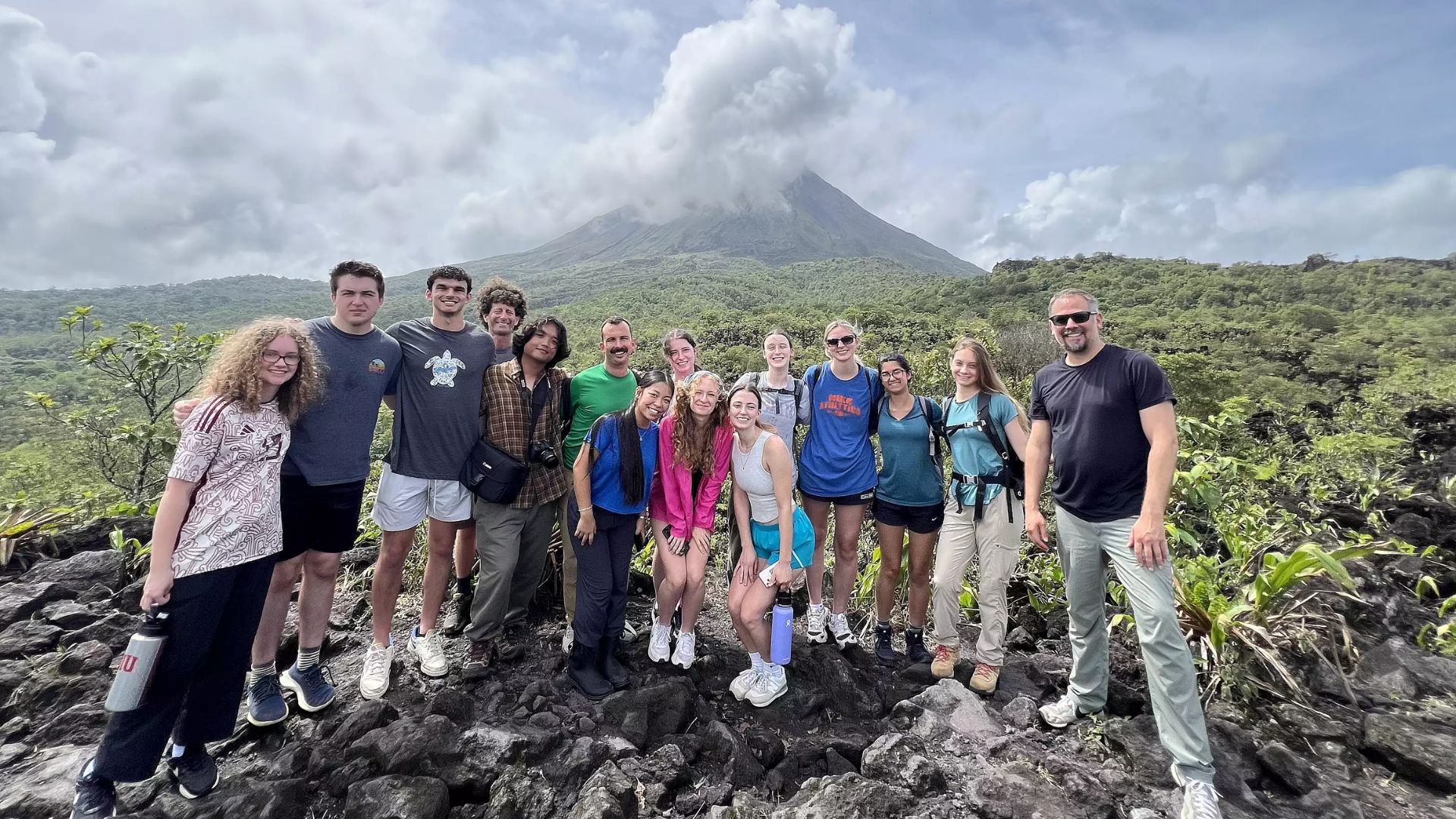
Students from Indiana University play a central role as well. Undergraduate and graduate researchers participate in fieldwork across multiple countries, gaining hands-on experience that often shapes their future careers in academia, public health, and government.
“I really think experiential learning is critical,” Wasserman said. “Independent research, study abroad opportunities, and fieldwork give students a way to see how science connects directly to people’s lives.”
As director of the Human Biology Program, Wasserman is working to expand these opportunities for students across IU campuses.
As agricultural systems continue to intensify worldwide, the implications of this research extend far beyond Uganda. By tracing how human decisions ripple through shared environments and across species, the project offers a clearer picture of the hidden connections between food production, health, and the ecosystems people and wildlife depend on every day.


