
Indianapolis, Indiana – Indiana University researchers are making strides in musculoskeletal health, developing new treatments and technologies that improve mobility, accelerate recovery, and support communities across the state. Their work spans the study of bone strength, fracture healing, and musculoskeletal function, and it is bolstered by collaborations with industry leaders, academic institutions, and local volunteers.
Musculoskeletal injuries affect people of all ages and lifestyles. A child might break a bone on a playground, an athlete could tear a ligament, and older adults can lose independence following a hip fracture. Low bone density is a major contributor: half of women and a quarter of men over 50 will experience a fracture in their lifetime, and roughly 300,000 hip fractures occur annually in the U.S. Studies show that 20 to 30 percent of older adults who suffer a hip fracture die within a year.
“In order for Hoosiers to have the life they want, they need to be able to move well,” said Melissa Kacena, professor of orthopedic surgery at the IU School of Medicine and a leading bone researcher. “Whether it’s picking up your grandkids, running a marathon or being able to work, if we can’t move the way we want to, we aren’t living our best lives.”
IU’s research builds on Indiana’s reputation as a global hub for orthopedic innovation. Warsaw, Indiana, just 50 miles from Fort Wayne, is home to more than 25 medical device companies, including DePuy Synthes and Zimmer Biomet. The region produces almost two-thirds of the world’s orthopedic devices and is widely known as the “orthopedic capital of the world.”
Leveraging this expertise, IU launched the Indiana Musculoskeletal Health Partnership for the Advancement of Care & Treatment, known as IMPACT. The statewide consortium is led by Kacena as principal investigator. Amrou Awaysheh, OneAmerica Foundation Endowed Chair and associate professor at the IU Kelley School of Business, serves as chief technology and innovation officer, while neuroscientist Jill Fehrenbacher is chief learning officer. Jim Lancaster, an orthopedic industry executive, acts as interim CEO.
IMPACT brings together more than 100 research, industry, and clinical partners, including Eli Lilly, Zimmer Biomet, IU Health, OrthoIndy, the University of Notre Dame, and Purdue University. Through collaborative research, development, and workforce training, IMPACT seeks to advance both patient care and the state’s thriving orthopedic industry.
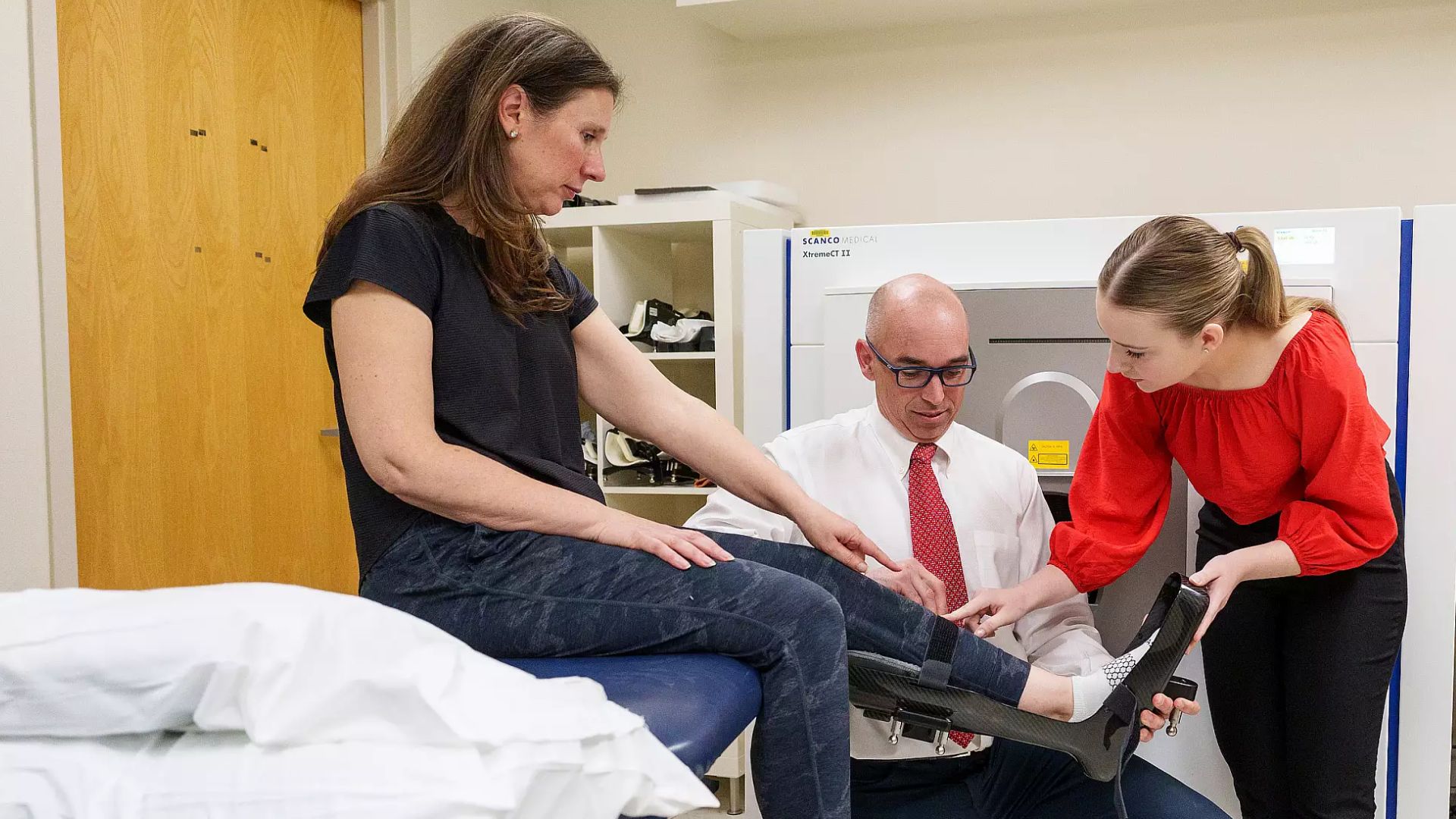
While IU researchers pioneer new treatments, they are also providing access to data and research resources for scientists worldwide. The Function, Imaging, and Testing Core, or FIT Core, is part of IU’s Indiana Center for Musculoskeletal Health. Volunteers in Indianapolis, ranging in age from 5 to 100, participate in tests evaluating gait speed, balance, strength, bone composition, and overall musculoskeletal function.
The data collected at the FIT Core is de-identified and added to a repository used by around 50 approved researchers across IU and internationally. Stuart Warden, FIT Core director and associate dean for research at the IU School of Health & Human Sciences, said the program allows scientists to compare findings across populations while providing volunteers with valuable personal health insights.
For instance, Indianapolis resident Karen Rothbaum discovered through FIT Core testing that she was at risk for osteoporosis despite an athletic lifestyle and lifelong dedication to tennis. “Dr. Kacena invited me to the lab to assess my risk for musculoskeletal disorders,” Rothbaum said. “Despite an athletic upbringing and a lifelong passion for tennis, I discovered I’m at risk for osteoporosis. Now I’m taking proactive steps to protect my bone health.”
To reach aging and rural communities, Kacena is launching MSKMobile, a fully equipped mobile healthcare and research unit. The service will travel across Indiana, screening volunteers for bone mineral density and other indicators of musculoskeletal health, expanding access to preventive care and research participation beyond urban centers.
IU’s research also intersects with space medicine and smart manufacturing. Kacena’s studies of bone and blood formation have produced patented drug technologies that accelerate bone recovery, potentially helping patients heal faster after fractures. These innovations have drawn interest from NASA and the U.S. Department of Defense, with potential applications ranging from supporting astronauts on long space missions to treating injuries caused by explosives.
Meanwhile, IU’s Kelley School of Business, through the Business Sustainability and Innovation Lab directed by Awaysheh, is improving orthopedic manufacturing in Indiana. Over 100 master’s students collaborated with a Warsaw-based company to create a more responsive supply chain using artificial intelligence. This system collects real-time data, enabling more efficient manufacturing, faster delivery of accurate implants, and improved patient care.
“Our work also extends beyond the supply chain into digitizing manufacturing,” Awaysheh said. “Think of your house. Older homes have light switches and dial thermostats. Now you see smart switches that sense when someone enters the room, and we can control the temperature remotely to only be on when the space is being used. These same principles are going to advance manufacturing. We can use similar concepts to digitize legacy manufacturing lines.”
The integration of medical research, engineering, and industry expertise underscores IU’s approach to musculoskeletal health. By combining laboratory research, clinical studies, and advanced manufacturing techniques, the university is creating a comprehensive ecosystem that supports both patient care and innovation.
Beyond improving treatment outcomes, IU’s initiatives aim to equip the next generation of researchers and practitioners. Through IMPACT and partnerships with educational institutions, students gain hands-on experience with cutting-edge musculoskeletal technologies and research methods. These experiences prepare them for careers in healthcare, biomedical engineering, and related fields, ensuring a pipeline of skilled professionals to continue advancing the field.
Collaboration remains central to IU’s mission. The university works with local industry leaders, national research centers, and global health organizations to share knowledge, data, and technologies. This cooperative model accelerates innovation and ensures that advancements in musculoskeletal health reach patients as quickly as possible.
By addressing both preventive care and treatment, IU researchers are taking a holistic approach. Programs like the FIT Core and MSKMobile identify individuals at risk for musculoskeletal disorders, while laboratory research and drug development create new therapeutic options. The combination of patient-focused care and scientific innovation positions Indiana as a leader in the field.
The impact of IU’s musculoskeletal research extends beyond individual patients. By improving mobility, accelerating recovery from injury, and enhancing manufacturing processes for orthopedic devices, the work contributes to economic growth, strengthens healthcare infrastructure, and positions Indiana as a hub for innovation in musculoskeletal health.
As the population ages and musculoskeletal disorders become more prevalent, Indiana University’s approach offers hope for healthier, more active lives. From children to seniors, athletes to astronauts, the research, treatments, and technologies developed at IU are helping people maintain mobility, independence, and quality of life.
Through collaboration, innovation, and a commitment to translating research into real-world solutions, IU is advancing musculoskeletal health in ways that benefit patients, communities, and the global scientific community alike. As these efforts continue, Hoosiers and others worldwide may see faster recovery times, better treatments, and enhanced mobility, reflecting the university’s dedication to improving lives through science and innovation.


