
Monroe County, Indiana – Walk into a Monroe County Community School Corporation classroom, and the rhythm of learning feels deliberate, personal, and alive. Students are not simply listening and moving on. They are checking their understanding, asking questions, and getting exactly the help they need at the right moment. In MCCSC schools, instruction is intentionally designed to reach every learner—and students can explain how it works.
One elementary student described the process in simple terms that reflect a much larger instructional philosophy. “We do exit tickets to see what we’re good at and still need help with. My teacher goes through the slides to help us, and she teaches us at the teacher table.” That daily routine—small checks for understanding followed by focused support—has become a cornerstone of learning across MCCSC K–8 classrooms.
Teachers regularly pause instruction to see where students are, then respond with targeted lessons, small groups, or one-on-one help. This constant feedback loop ensures no student is left guessing or falling behind unnoticed. “Behind each chart, each data point, there is a child learning to believe, ‘I can do this,’” said Lily Albright, MCCSC’s director of elementary education. “And our educators are building those moments—every day.”
The district’s approach is grounded in research and aligned with Indiana Academic Standards. In literacy, instruction centers on how language works. Students learn sounds, spelling patterns, and word structures through a research-backed approach known as the science of reading. This method emphasizes explicit, systematic instruction and has been proven to help more students learn to read successfully.
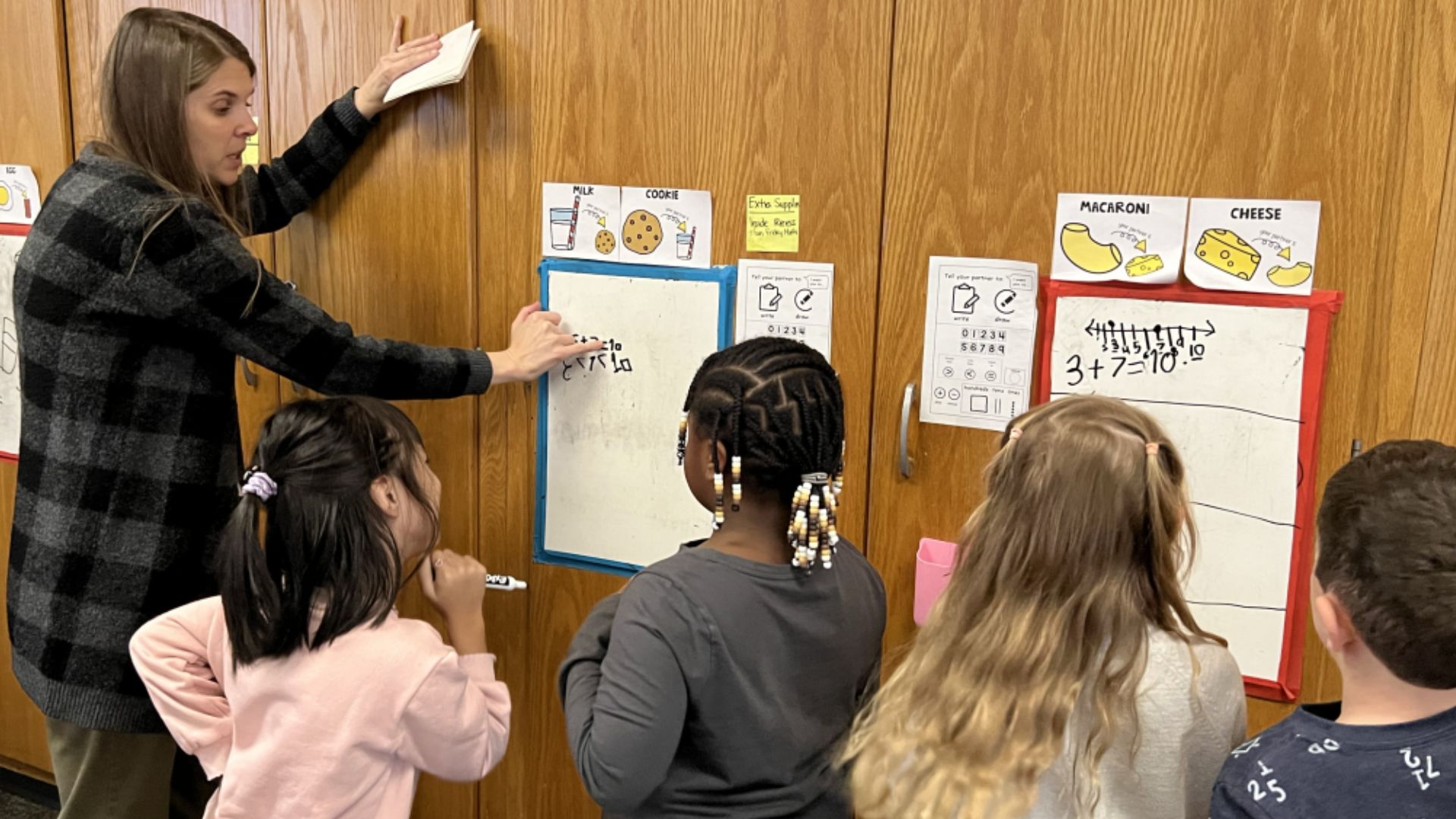
In math, learning is active and intentional. Teachers don’t just present answers—they model how mathematical thinking works. Problems are broken down step by step, with teachers explaining the “why” behind each move. Students work independently, collaborate in small groups, and use hands-on tools to explore concepts. Whole-class discussions allow students to share how they solved problems, reinforcing effective strategies and deepening understanding.
Supporting this work is a strong focus on professional learning. MCCSC provides ongoing, job-embedded training for teachers throughout the year. The district also partners with national experts, including Dr. Jamey Peavler for literacy and Dr. Laurie Ferry for math, to strengthen instruction and ensure teachers have the tools they need to meet diverse learning needs.
A key part of MCCSC’s instructional model is progress monitoring. Three times a year, teachers assess every student in reading and math to understand exactly what they know and where they need support. Instruction is then adjusted every two to three weeks based on how students are progressing. This flexibility allows teachers to respond quickly rather than waiting for gaps to widen.
“Progress monitoring has become an integral part of our work,” one MCCSC principal shared. “We have an all-hands-on-deck approach to support each student.” Teachers, specialists, and school leaders work together to review data and plan next steps, keeping student growth at the center of every decision.
For students, assessments are not treated as high-pressure events. Instead, they are routine tools that help guide learning. Over time, this approach changes how students see themselves as learners. “We’re not just learning and then forgetting—we take assessments to see what we remember,” one student explained. “Sometimes they’re hard, but if I’ve already learned it, not so much! This year is really fun!”
That mindset shift matters. When assessments become part of learning rather than a judgment, students focus on progress instead of pressure. Albright noted that MCCSC students in grades 3–8 perform nearly 13 percentage points above the state average on ILEARN math assessments. Still, she emphasizes that scores are only part of the story.
“For students, assessments aren’t about scores or pressure—they’re about noticing their own growth,” said Albright. “The joy this student feels comes from the sense of progress and the understanding that learning builds over time.”
Looking ahead, MCCSC is not standing still. “We’re proud of where we are, and even more excited about where we’re going,” Albright said. The district plans to adopt a new evidence-based English language arts curriculum for the 2026–27 school year, continuing its commitment to research-driven instruction that meets students where they are.
In MCCSC classrooms, learning is intentional, responsive, and rooted in belief—belief in strong teaching, in thoughtful instruction, and in every student’s ability to grow.


