
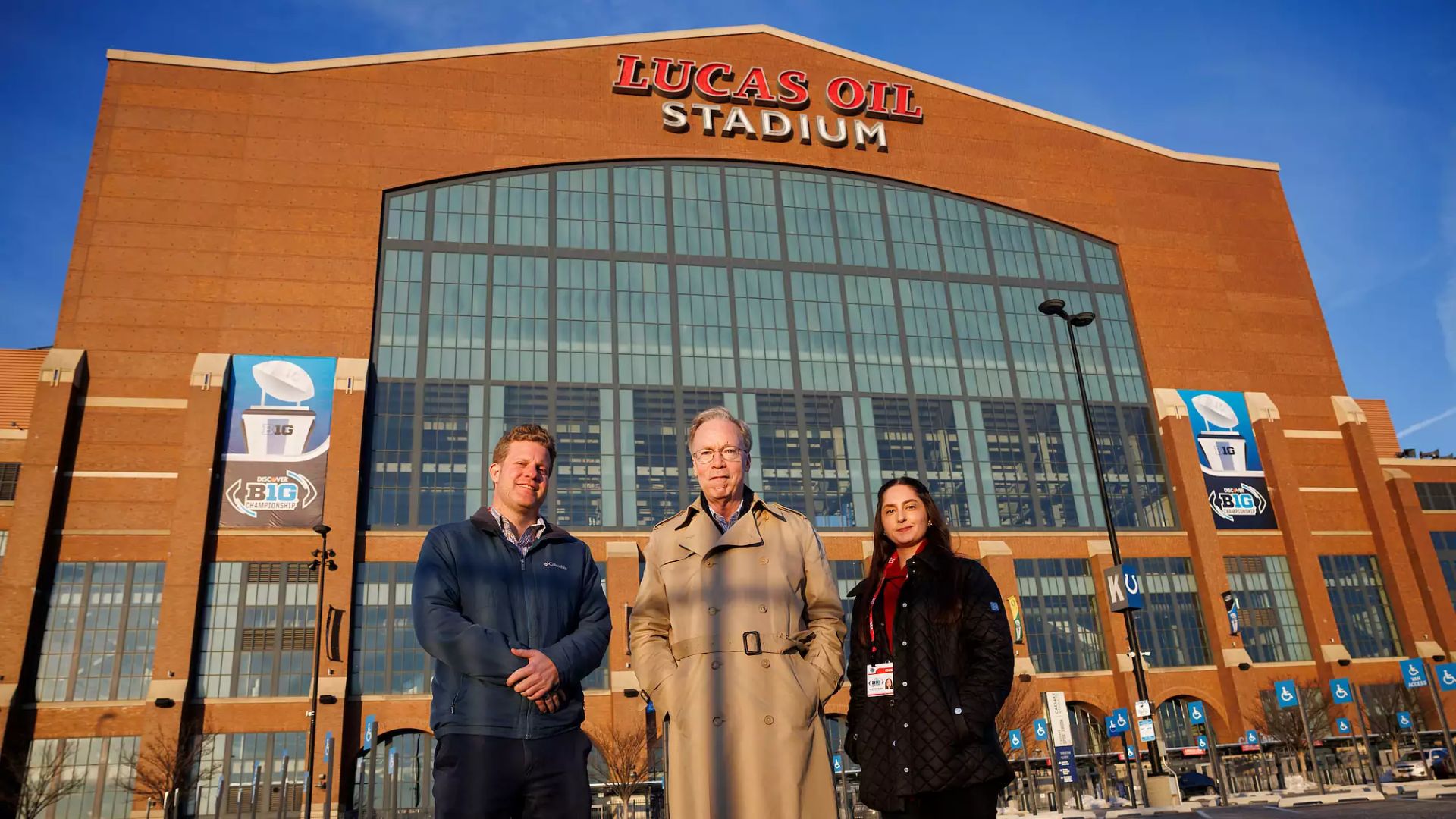
Indianapolis, Indiana – The roar inside Lucas Oil Stadium on December 6 could be felt from the concrete floor to the uppermost rafters. Indiana and Ohio State, ranked the top two teams in the nation, were minutes from deciding a Big Ten Championship that had gripped fans across the Midwest. While tens of thousands of spectators packed the stadium for the showdown, two graduate students from the Sports Capital Journalism Program at Indiana University Indianapolis occupied seats that offered a completely different experience. From their position in the press box, master’s students Sara Jane and Chris Schumerth weren’t cheering or chanting—they were watching with sharpened attention, collecting facts and moments as the Hoosiers battled to a hard-fought 13–10 victory that stunned the college football world.
For the students, the assignment was more than just attending a major game. It represented one of the many real-world opportunities woven into the Sports Capital Journalism program, which has built a national reputation for giving aspiring sports writers access to some of the biggest events in the country. Under the direction of Malcolm Moran, the program routinely places students in the middle of coverage teams working bowl games, championships, international competitions, and iconic races. Those opportunities have helped alumni like Zach Powell and Zak Keefer of The Athletic and award-winning writer Brian Burnsed develop careers shaped by firsthand reporting experience.
A Championship Night and a Crash Course in Deadline Writing
Jane and Schumerth entered the press box just as reporters from across the country were settling in. Surrounded by veteran journalists typing away, refreshing stat feeds, and adjusting headsets, the two students quickly settled into their roles. While the stadium crackled with tension, they were cataloging every pivot of momentum, keeping track of key plays, and preparing to translate the emotional weight of the night into clear reporting.
Jane, a first-year graduate student earning her Master of Arts in sports journalism, focused her attention on Indiana quarterback Fernando Mendoza, who had become one of the defining figures of the Hoosiers’ season. After the game, she followed the wave of reporters headed toward the press junket. There, amid the chaos of post-game celebrations, she gathered comments from players such as wide receiver Charlie Becker. The main press conference—including Mendoza and head coach Curt Cignetti—took place in a separate room, so Jane later stitched together her story using the recorded interview along with material she collected firsthand. The work kept her awake deep into the early morning hours. She finally completed her piece at around 5 a.m., a rite of passage familiar to any journalist who has lived through the reality of deadline reporting.
Her journey to Indianapolis began far from the Midwest. Born in Minas Gerais, Brazil, Jane grew up surrounded by a sports culture shaped by soccer and Formula 1. After finishing her journalism degree at Methodist University of São Paulo, she wanted a place where she could combine her writing ambitions with access to meaningful sporting events. Indiana—and the Sports Capital Journalism program—quickly rose to the top of her list.
“IU was on the top of my list because of the opportunities in this program and in the city of Indianapolis,” she said. “We have so many sports around here. It was the best choice that I could have ever made.”
Her portfolio expanded almost immediately after joining the program. By May, she was covering the Indianapolis 500. The assignment was particularly meaningful: she had long been a Formula 1 enthusiast, having grown up watching the Grand Prix and even covering the São Paulo race during a TV station internship.
“My favorite sports are soccer and Formula 1, but since I got here, I’ve been learning about football a lot, and now it’s one of my favorites sports as well,” she said. “I really like basketball, too, and having the Pacers and Fever here is great. I also had the opportunity to cover the Big Ten Basketball Championship earlier this year.”
With the NCAA Men’s Final Four coming to Indianapolis this spring—and coinciding with the D-II, D-III, and NIT finals—Jane is preparing for what will be a historic week in college basketball. It will mark the first time all four championships are decided in the same city.
A Writer Drawn Back to the World of Sports
Schumerth’s path into the program is equally layered. A full-time academic advisor at IU Indianapolis and a freelance writer, he already held a bachelor’s degree and an MFA in creative writing before turning toward sports journalism. For years, he worked as a high school sports referee, but a knee injury and several surgeries pushed him away from the officiating world. Later, an article about Sports Capital Journalism students covering the Olympics caught his attention. He reached out to Moran, and soon found himself pursuing a degree that merged the storytelling he loved with the energy of sports environments he had always enjoyed.
Schumerth soon found himself covering major events too. His first large-scale assignment came at the 2025 Sugar Bowl in New Orleans, where Notre Dame faced Georgia. As someone who grew up cheering for Notre Dame—his grandfather was both an alumnus and a football coach—the experience was overwhelming at first.
“When you first experience that environment, it’s like deer in the headlights,” Schumerth said.
Moran says that reaction is common among new students. Entering crowded press rooms, managing interview sessions under time pressure, and working beside seasoned professionals can create intense anxiety.
“The most important principle is the value of preparation to create a plan for approaching interview sessions and the ability to immediately retrieve information while writing on deadline,” Moran said.
Over time, Schumerth developed a stronger workflow and a clearer sense of purpose when entering chaotic media areas.
“I will say that I now go into these situations with a much better plan and clearer sense of what I’m trying to ask about,” he said. “‘This is who I want to talk to. This is what I want to ask.’”
His coverage of the Big Ten Championship provided a broad, narrative-driven view of the game, but he enjoys digging below the surface. What excites him most is uncovering human details—the emotional threads that run beneath wins and losses.
“That’s the kind of stuff I love: threads and angles to stories that go a little bit beyond games,” Schumerth said.
Looking Ahead to the Heisman and the Rose Bowl
Schumerth is part of the first group of students who will travel to New York to cover the Heisman Trophy announcement. The stakes are high this year. IU quarterback Fernando Mendoza—nicknamed “HeisMendoza”—is a finalist alongside Ohio State’s Julian Sayin, Notre Dame’s Jeremiyah Love, and Vanderbilt’s Diego Pavia. Mendoza’s undefeated 13-0 season and Indiana’s first-ever No. 1 ranking have made him a strong favorite.
For the students, the Heisman assignment will be another step into journalism’s highest-profile spaces. In January, they will travel again, this time to Pasadena, to cover Indiana’s appearance in the Rose Bowl.
A Program Built on Experience
The Sports Capital Journalism Program has long embraced the idea that the best training for a journalist comes from doing the real work—gathering quotes, hunting for storylines, navigating crowded locker rooms, and racing deadlines. Indianapolis, a hub for major sports events, gives students access to experiences that most young journalists can only dream of.
For Jane and Schumerth, the Big Ten Championship was more than a football game. It was a night of intense learning, fast thinking, and firsthand insight into the pace of sports journalism. Their journey into the profession continues—with more stadiums to enter, more interviews to conduct, and more stories to shape as they follow the Hoosiers from the Midwest to New York to California.
In the end, their work reflects the heart of the program: teaching students not just to observe sports moments, but to capture them—fully, vividly, and with the curiosity that drives great storytelling.


